Mostrando las entradas con la etiqueta lectura y sordera. Mostrar todas las entradas

18 noviembre, 2010

Invitación a lanzamiento del "Programa Inicial de Lectura y Escritura para Sordos"


Se invita a participar del lanzamiento del "Programa Inicial de Lectura y Escritura para Sordos" -realizado por la Dra. Valeria Herrera- el cual es producto de tres años de ardua investigación aplicada financiada por FONDECYT (11075018). 

El lanzamiento, seguido de un Seminario de Capacitación en el uso del programa, se llevará a cabo el lunes 22 de noviembre de 15 a 18:30 horas en el Aula Virtual de la Universidad Metropolitana de Ciencias de la Educación, (J. P. Alessandri 774. Ñuñoa).

Dado que este evento es gratuito se solicita confirmar su asistencia mediante correo a Ignacia Sauvalle: inasauvalle@gmail.com o al fono 5561263-5511561.

En dicha oportunidad estará disponible para la compra el texto del Programa.

24 febrero, 2009

Publicado Capítulo “Situación de la educación de los sordos en Chile” en el Informe Mundial “Deaf people around the world. Educational, develomental and social perspectives”.

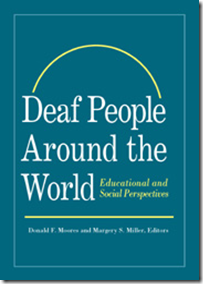
Valeria Herrera (UMCE), Anibal Puente y Jesús Alvarado (UCM) han publicado recientemente el Capítulo relativo a la educación de los sordos en Chile, en un libro coordinado por Donald Moore y Margery Miller llamado “Deaf people around the world. Educational, develomental and social perspectives” Washington, Gallaudet University Press. 2009. A continuación una breve reseña en inglés.


image

Deaf People Around the World

Educational and Social Perspectives

Donald F. Moores and
Margery S. Miller, Editors

April 2009  $85.00s

Shopping Cart Operations Add to Cart
Review Or Change Cart Contents
Buy This Book Now Secure Checkout


In Deaf People Around the World: Educational and Social Perspectives, the leading researchers in 30 nations describe the shared developmental, social, and educational issues facing deaf people filtered through the prism of unique national, regional, ethnic, and racial realities. Editors Donald F. Moores and Margery S. Miller have organized this remarkable collection in five major sections: Asia/Pacific, the Middle East and Africa, Europe, North and South America, and International Developments, which includes the International Committee on Sports for the Deaf and the World Federation of the Deaf.

More than 50 internationally recognized scholars provide a historical view of the education and treatment of deaf people in their respective countries. They examine a wide range of issues, including current academic placement; communication modes used in schools; the recognition of sign languages; the curricula of the deaf schools versus that of regular schools; for secondary and postsecondary opportunities; the status of deaf adults; deaf teachers; special laws if any; the preparation of teachers, psychologists, therapists, and other special personnel who work with deaf clients; and current trends and developments in their countries.

Deaf People Around the World reveals that deaf people generally have gained a sense of confidence, empowerment, and global awareness of their shared experience. Many have seen significant improvement in their lives from greater educational and professional opportunities. Finally, more deaf leaders argue that the pathological model of deafness must be abandoned to continue this marked progress for deaf people around the world.

Donald F. Moores is Professor, Department of Exceptional Student and Deaf Education, University of North Florida, Jacksonville, FL.

Margery S. Miller is Associate Dean, Enrollment Management, at Gallaudet University, Washington, DC.

ISBN 1-56368-410-1, 978-1-56368-410-4, 7 x 10 casebound, 416 pages, photographs, figures, tables, references, index


Shopping Cart Operations

To order by mail, print our Order Form or call:

TEL 1-800-621-2736; (773) 568-1550 8 am - 5 pm CST
TTY 1-888-630-9347
FAX 1-800-621-8476; (773) 660-2235


Etiquetas de Technorati: Democracia,discapacidad,educación,integración escolar,lectura y sordera,literacy and deafness,necesidades educativas especiales,paradigmas educativos,reading

DISCAPACIDAD Y NECESIDADES EDUCATIVAS ESPECIALES: NUEVOS PARADIGMAS EN LA ATENCIÓN A LA DIVERSIDAD.

Valeria Herrera Fernández. Dra en Psicología, UCM. valeria2hf@yahoo.com
Publicado originalmente en Revista de Pedagogía Crítica Paulo Freire. Año 7, Nº 5, pp. 83- 93.

RESUMEN
Este artículo presenta una reflexión crítica sobre los cambios paradigmáticos acaecidos en las formas de abordar las necesidades educativas especiales de los alumnos con discapacidad. El cambio de paradigmas operado en las últimas décadas ha repercutido fuertemente tanto en el rol de la educación especial como en el de la educación común, así como en sus relaciones con la integración escolar. En este sentido, se pretende analizar cómo el actual paradigma postula que las dificultades de aprendizaje son el resultado de la interacción entre las características de los estudiantes, los factores sociales y ambientales y las condiciones de escolarización.
PALABRAS CLAVES: discapacidad, paradigmas educativos, integración escolar.

23 febrero, 2009

HABILIDAD LINGÜÍSTICA Y FRACASO LECTOR EN LOS ESTUDIANTES SORDOS - LINGUISTIC SKILLS AND READING FAILURE IN THE DEAF STUDENTS


Resumen
Uno de los mayores problemas que plantea la pérdida auditiva es la dificultad para acceder al lenguaje escrito y a la capacidad de alcanzar una competencia lectora adecuada y funcional. En este artículo se presenta una revisión de las principales investigaciones llevadas a cabo durante los últimos 40 años, respecto de las causas que originan el fracaso lector de los estudiantes sordos. Se analizan las habilidades léxicas, sintáctica, semánticas y pragmáticas del lenguaje.

Palabras clave: habilidad linguística, aprendizaje,lectura y sordera.

Abstract
One of the mains problems than cause the hearing loss is correct access to the written language and the capacity to achieve a suitable and functional reading skill. In this article a revision of the main investigations carried out appears during last the 40 years, respect to the causes that originate the reading failure of the deaf students. The abilities lexical, syntactic, semantic and pragmatic of the language are analyzed.
Key Words: linguistic skill, learning, literacy and deafness